Coarse-Grained Molecular Dynamics
Problem of Scale
One of the main unresolved problems in biological science
is the time-scale and length-scale gap between computational
and experimental methods of studying biological systems.
Chemical and mechanical processes on an atomic level form the basis
of all phenomena in living systems. The experimental non-invasive observation
of such dynamic processes would be greatly beneficial for
understanding how life works; however, usually experimental
techniques do not achieve a resolution better than ms-&mus in time.
On the other hand, there exist theoretical and
computational methods, in particular molecular modeling, that enable
the description of biological systems with all-atom detail. However
up to now these approaches have been practically limited to
simulation times and system sizes less than 100 ns and 10 nm, respectively.
A possible way to extend molecular modeling and bridge it
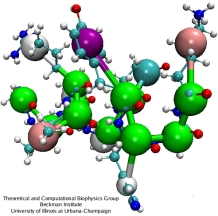
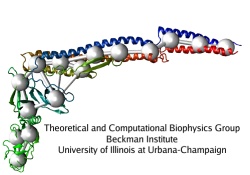
with experimental techniques is to use coarse-graining: to represent a system
by a reduced (in comparison with an all-atom description)
number of degrees of freedom. Due to the reduction in
the degrees of freedom and elimination of fine interaction details,
the simulation of a coarse-grained (CG) system requires less resources and goes
faster than that for the same system in all-atom representation. As a result,
an increase of orders of magnitude in the simulated time and length scales can be
achieved.
We have developed two CG approaches to address various scales
in biomolecular simulations: the residue-based CG
(Shih et al., 2006;
Shih et al., 2007)
and the shape-based CG
(Arkhipov, Freddolino, and Schulten, 2006;
Arkhipov, Yin, and Schulten, 2008).
Please see short descriptions for each of the two methods in the following pages:
Residue-Based Coarse Graining: a Coarse-Grained Lipid-Protein Model
Shape-Based Coarse Graining: an Approach to Model Large Macromolecular Assemblies
Publications
Publications Database
Membrane-bending mechanism of amphiphysin N-BAR domains.
Anton Arkhipov, Ying Yin, and Klaus Schulten. Biophysical Journal, 97:2727-2735, 2009.
Elucidating the mechanism behind irreversible deformation of viral capsids.
Anton Arkhipov, Wouter H. Roos, Gijs J. L. Wuite, and Klaus Schulten. Biophysical Journal, 97:2061-2069, 2009.
Simulations of membrane tubulation by lattices of amphiphysin N-BAR domains.
Ying Yin, Anton Arkhipov, and Klaus Schulten. Structure, 17:882-892, 2009.
Transport-related structures and processes of the nuclear pore complex studied through molecular dynamics.
Lingling Miao and Klaus Schulten. Structure, 17:449-459, 2009.
Molecular models need to be tested: the case of a solar flares discoidal HDL model.
Amy Y. Shih, Stephen G. Sligar, and Klaus Schulten. Biophysical Journal, 94:L87-L89, 2008.
Four-scale description of membrane sculpting by BAR domains.
Anton Arkhipov, Ying Yin, and Klaus Schulten. Biophysical Journal, 95:2806-2821, 2008.
Application of residue-based and shape-based coarse graining to biomolecular simulations.
Peter L. Freddolino, Anton Arkhipov, Amy Y. Shih, Ying Yin, Zhongzhou Chen, and Klaus Schulten. In Gregory A. Voth, editor, Coarse-Graining of Condensed Phase and Biomolecular Systems, chapter 20, pp. 299-315. Chapman and Hall/CRC Press, Taylor and Francis Group, 2008.
Molecular modeling of the structural properties and formation of high-density lipoprotein particles.
Amy Y. Shih, Peter L. Freddolino, Anton Arkhipov, Stephen G. Sligar, and Klaus Schulten. In Scott Feller, editor, Current Topics in Membranes: Computational Modeling of Membrane Bilayers, chapter 11, pp. 313-342. Elsevier, 2008.
Molecular models need to be tested: the case of a solar flares discoidal HDL model.
Amy Y. Shih, Stephen G. Sligar, and Klaus Schulten. Biophysical Journal, 94:L87-L89, 2008.
Assembly of lipoprotein particles revealed by coarse-grained molecular dynamics simulations.
Amy Y. Shih, Peter L. Freddolino, Anton Arkhipov, and Klaus Schulten. Journal of Structural Biology, 157:579-592, 2007.
Assembly of lipids and proteins into lipoprotein particles.
Amy Y. Shih, Anton Arkhipov, Peter L. Freddolino, Stephen G. Sligar, and Klaus Schulten. Journal of Physical Chemistry B, 111:11095-11104, 2007.
Disassembly of nanodiscs with cholate.
Amy Y. Shih, Peter L. Freddolino, Stephen G. Sligar, and Klaus Schulten. Nano Letters, 7:1692-1696, 2007.
Stability and dynamics of virus capsids described by coarse-grained modeling.
Anton Arkhipov, Peter L. Freddolino, and Klaus Schulten. Structure, 14:1767-1777, 2006.
Coarse-grained molecular dynamics simulations of a rotating bacterial flagellum.
Anton Arkhipov, Peter L. Freddolino, Katsumi Imada, Keiichi Namba, and Klaus Schulten. Biophysical Journal, 91:4589-4597, 2006.
The role of molecular modeling in bionanotechnology.
Deyu Lu, Aleksei Aksimentiev, Amy Y. Shih, Eduardo Cruz-Chu, Peter L. Freddolino, Anton Arkhipov, and Klaus Schulten. Physical Biology, 3:S40-S53, 2006.
Coarse grained protein-lipid model with application to lipoprotein particles.
Amy Y. Shih, Anton Arkhipov, Peter L. Freddolino, and Klaus Schulten. Journal of Physical Chemistry B, 110:3674-3684, 2006.
Investigators
Collaborators
Related TCB Group Projects
Page created and maintained by Anton Arkhipov.