|
|
Spotlight
|
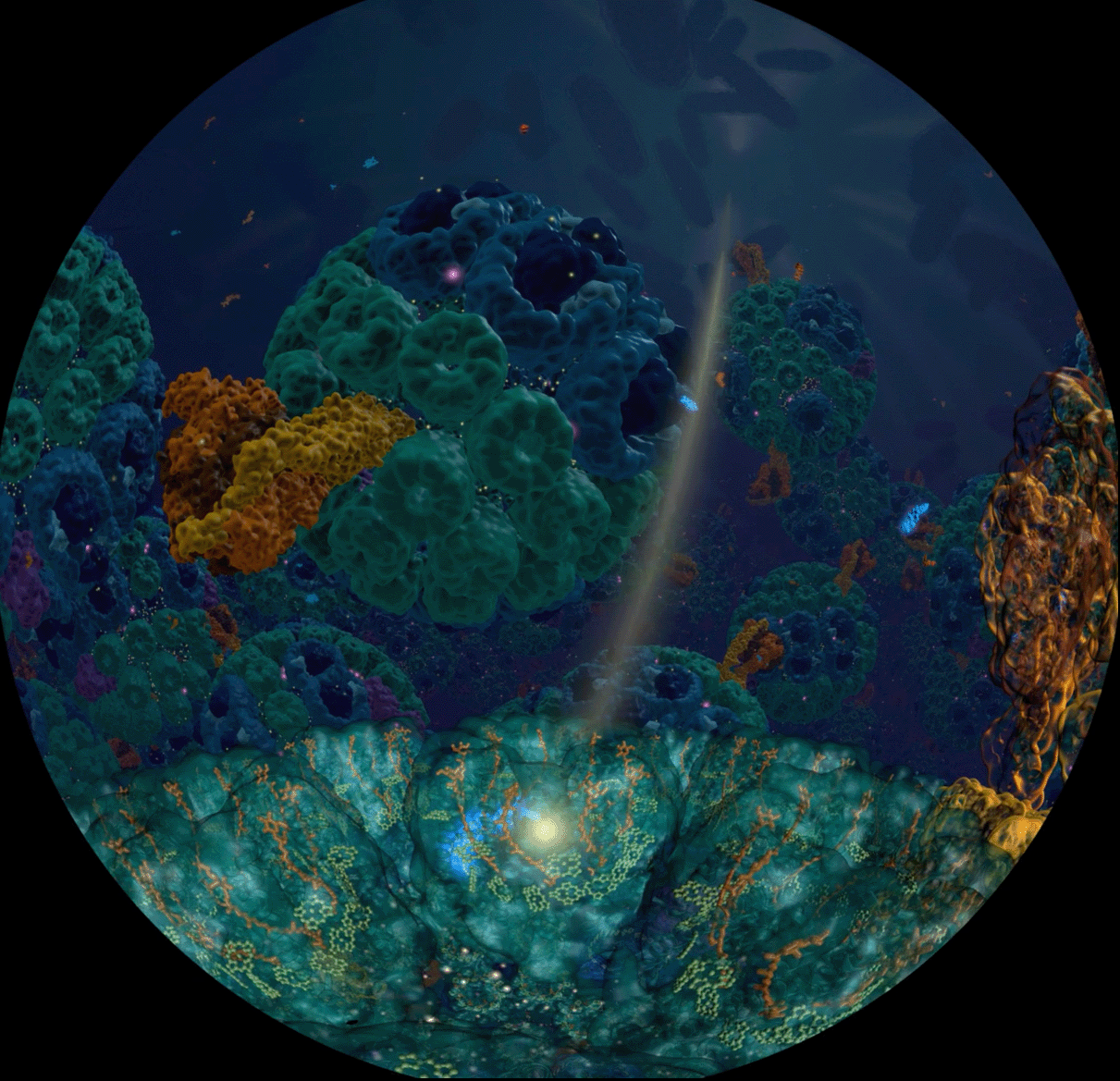
image size:
|
Overview
Molecular representations
VMD plugin library
Molecular file formats
GPU-accelerated computing
Interactive molecular dynamics
Programs that use VMD
VMD research publications
How to cite VMD
VMD citation list (37,000 as of Mar'21)
Download
Download (all versions)
VMD 2.0.0 alpha (Unix)
VMD 1.9.4 (MacOS X, Unix, Windows)
VMD 1.9.3 (MacOS X, Unix, Windows)
VMD script library
License, Copyright and Disclaimer
Documentation and Support
User and installation guidesVMD-L mailing list
Publication image tutorial (YouTube)
Quick help
FAQ
Bug List
News and Announcements
Dynamics of chromosome organization in a minimal bacterial cell, FCDB, 2023

VMD as a Platform for Interactive Small Molecule Preparation and Visualization in Quantum and Classical Simulations, JCIM, 2023
Human Learning for Molecular Simulations: The Collective Variables Dashboard in VMD, JCTC, 2022
ANARI: A 3D Rendering API Standard, CiSE, 2022
#COVIDisAirborne: AI-Enabled Multiscale Computational Microscopy of Delta SARS-CoV-2 in a Respiratory Aerosol, IJHPCA, 2022
Intelligent Resolution: Integrating Cryo-EM with AI-Driven Multi-Resolution Simulations to Observe the SARS-CoV-2 Replication-Transcription Machinery in Action, IJHPCA, 2022
The Coronavirus in a Tiny Drop, VMD visualizations of aerosolized SARS-CoV-2, NYT, 2021
NIH Director's blog highlights neuroscience adaptation of VMD
AI-driven multiscale simulations illuminate mechanisms of SARS-CoV-2 spike dynamics, IJHPCA, 2021
Multiscale modeling and cinematic visualization of photosynthetic energy conversion processes from electronic to cell scales, J. Par. Comp. 2021
NAMD and VMD part of the team winning the ACM COVID-19 Gordon Bell Prize for 2020
The Coronavirus Unveiled, VMD visualizations of SARS-CoV-2, NYT, 2020
Scalable molecular dynamics on CPU and GPU architectures with NAMD, JCP, 2020
VMD test builds for MacOS X 10.15 "Catalina" (April 24, 2020)
Past announcements
Gallery
An Accessible Visual Narrative for the Primary Energy Source of Life from the Fulldome Show Birth of Planet Earth, 1st Place Winner, SC'19 Viz. Showcase
Chromatophore VR demo (VMD + Unreal Game Engine) shown in NVIDIA booth at SC'16
Example VMD VR/3-D YouTube videos
Chemical Visualization of Human Pathogens: the Retroviral Capsids, Finalist, SC'15 Viz. Showcase
Visualization of Energy Conversion Processes in a Light Harvesting Organelle at Atomic Detail, 1st Place Winner, SC'14 Viz. Showcase
VMD movie gallery on YouTube
Gallery of Posters, Images, and Movies made with VMD
VMD running in the NanoDome at Temple University
Development
VMD User Survey Results
VMD development status and pre-release test downloads
CVS source code access
VMD Programmer's documentation