Resource Statistics Workshop on Computational Biophysics 2026
Follow \@tcbguiucHighlight: Delivering the 64th Hands-on Workshop on Computational Biophysics (Previous Highlights) Tweet
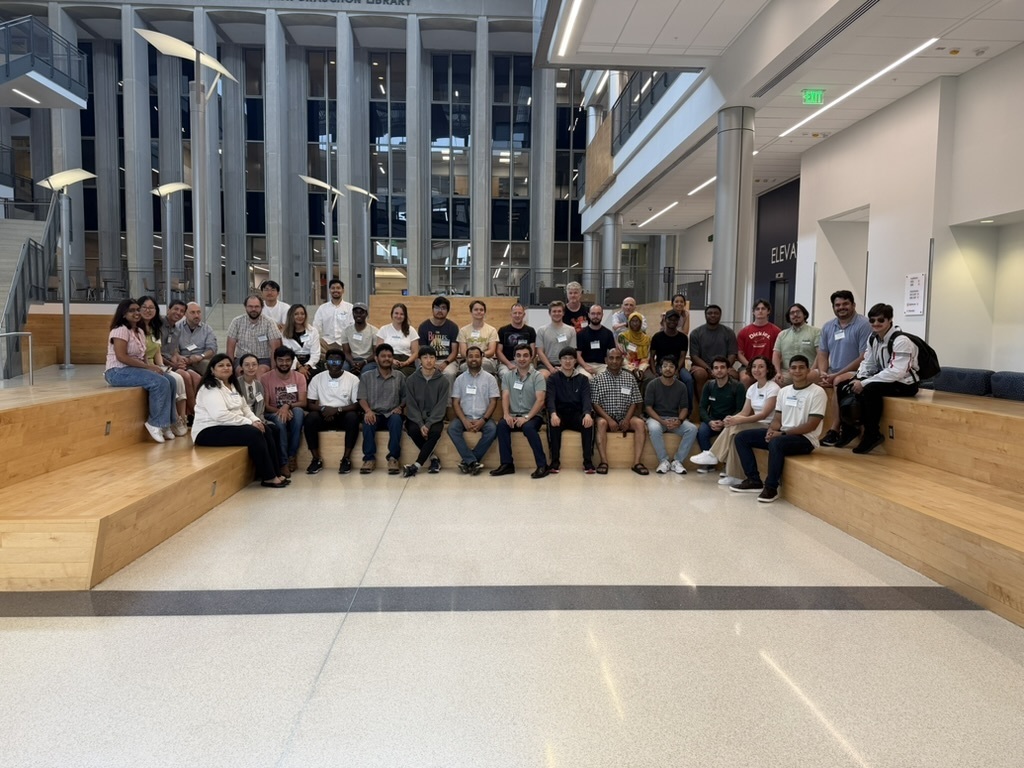
image size:
247.0KB
Workshop photo
The 64th Hands-on Workshop on Computational Biophysics took place at Auburn University between 6/22 - 6/26. This year we were able to host approximately 30 participants from all over the world! The workshop covered topics ranging from the basics of molecular dynamics to advanced free energy calculation and enhanced sampling methods, as well as molecular visualization, analysis, 3D rendering, and animations. The workshop employed the latest VMD 2.1 alpha pre-release! Stay tuned for upcoming workshops in the future!
The Future of Biomolecular Modeling
A 2015 TCBG Symposium brought together scientists from across the Midwest to brainstorm about what's on the horizon for computational modeling. See a summary of what these experts foresee.
Read more
Quantum Biology and Polyenes-When Theorists and Experimentalists Unite
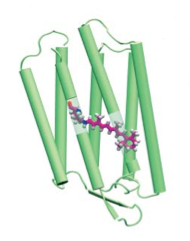
Starting with a discovery at Harvard in 1971 of a hidden state, Klaus Schulten spent a large portion of his career demystifying the polyenes, versatile molecules central to vision and photosynthesis. By Lisa Pollack.
Read more
Announcements
Seminars
Resource Usage
Remembering Klaus Schulten
Recent Publications All Publications
- Probing Solution Dynamics of Tissue Factor Using Molecular Dynamics Simulations Guided by NMR Chemical Shifts. J. Phys. Chem. B, 2026.
- Elucidating the binding and metabolic interactions of sunitinib and sorafenib with cytochrome P450s CYP2U1 and CYP2D6. Mol. Pharmacol., 108(4):100114. 2026.
- LetA defines a structurally distinct transporter family. Nature, 651(8107): 1097–1106. 2026.
- Single-Molecule Electron Transport in Peptoids. J. Phys. Chem. B, 130(11):3054–3064. 2026.
- Cholesterol efflux protein, ABCA1, supports anticancer functions of myeloid immune cells. Sci. Adv., 12(1):eadx5490. 2026.
- Thermodynamic and Kinetic Analysis of Molecular Conformational Dynamics in a Riemannian Framework. J. Phys. Chem. A, 130(5):1220–1232. 2026.
- Simulating Gas Permeation Through the Central Pore of AQP5. Adv Exp Med Biol., 1498:105–113. 2026.
Highly Cited
Generalized Verlet algorithm for efficient molecular dynamics simulations with long-range interactions. Molecular Simulation, 6:121-142, 1991.
Click here for other highly cited papers
Click here for other highly cited papers