James Gumbart
| |
|
Current location:
Assistant Professor
School of Physics
Georgia Institute of Technology
Atlanta, GA
gumbart_at_physics_dot_gatech_edu
|
Education:
- Director's Postdoctoral Fellow, Argonne National Lab, January 2011 - January 2013
- Ph.D. in Physics, University of Illinois, Urbana-Champaign, April 2009
- M.S. in Physics, University of Illinois, Urbana-Champaign, October 2005
- B.S. in Physics and Mathematics, Western Illinois University, May 2003
Research Interests:
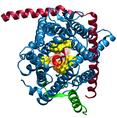
I am currently investigating the transport properties
of the membrane channel SecY. SecY is part of a three-protein complex that
serves to allow proteins to cross membranes or insert into them. This
task is so important that a form of the Sec system exists in each domain
of life! More information about this dynamic and multi-functional
protein can be found at our Protein
Translocation website.
|
Another interesting problem is how Gram-negative bacteria (those possessing
two membranes surrounding them) import large nutrients across the outer membrane. Since they cannot
generate energy at the outer membrane, they possess an inner membrane protein, TonB, that couples across
the periplasm to an outer membrane transporter in order to import large molecules, such as vitamin B12.
The mechanisms of this interaction and how it causes transport are still open questions in the field of microbiology.
|
Photosynthesis is an elemental process of nature and occurs not just in plants, but also
in some bacteria as well. In these bacteria, membrane-bound pseudo-organelles known as chromatophores contain the proteins
necessary to turn sunlight into chemical energy. These chromatophores come in different shapes depending on the
organism but no one knows how they self-assemble into spheres or sheets, one question we
now hope to answer.
|
Publications:
Publications Database
Symmetry-restrained flexible fitting for symmetric EM maps.
Kwok-Yan Chan, James Gumbart, Ryan McGreevy, Jean M. Watermeyer, B. Trevor Sewell, and Klaus Schulten. Structure, 19:1211-1218, 2011.
Free energy of nascent-chain folding in the translocon.
James Gumbart, Christophe Chipot, and Klaus Schulten. Journal of the American Chemical Society, 133:7602-7607, 2011.
Cryo-EM structure of the ribosome-SecYE complex in the membrane environment.
Jens Frauenfeld, James Gumbart, Eli O. van der Sluis, Soledad Funes, Marco Gartmann, Birgitta Beatrix, Thorsten Mielke, Otto Berninghausen, Thomas Becker, Klaus Schulten, and Roland Beckmann. Nature Structural & Molecular Biology, 18:614-621, 2011.
Free-energy cost for translocon-assisted insertion of membrane proteins.
James Gumbart, Christophe Chipot, and Klaus Schulten. Proceedings of the National Academy of Sciences, USA, 108:3596-3601, 2011.
Viewing the mechanisms of translation through the computational microscope.
James Gumbart, Eduard Schreiner, Leonardo G. Trabuco, Kwok-Yan Chan, and Klaus Schulten. In Joachim Frank, editor, Molecular Machines in Biology, chapter 8, pp. 142-157. Cambridge University Press, 2011.
Applications of the molecular dynamics flexible fitting method.
Leonardo G. Trabuco, Eduard Schreiner, James Gumbart, Jen Hsin, Elizabeth Villa, and Klaus Schulten. Journal of Structural Biology, 173:420-427, 2011.
Self-assembly of photosynthetic membranes.
Jen Hsin, Danielle E. Chandler, James Gumbart, Christopher B. Harrison, Melih Sener, Johan Strumpfer, and Klaus Schulten. ChemPhysChem, 11:1154-1159, 2010.
Molecular Mechanisms of Active Transport Across the Cellular Membrane, chapter 10, pp. 248-286.
Po-Chao Wen, Zhijian Huang, Giray Enkavi, Yi Wang, James Gumbart, and Emad Tajkhorshid. Royal Society of Chemistry, 2010.
Structure of monomeric yeast and mammalian Sec61 complexes interacting with the translating ribosome.
Thomas Becker, Shashi Bhushan, Alexander Jarasch, Jean-Paul Armache, Soledad Funes, Fabrice Jossinet, James Gumbart, Thorsten Mielke, Otto Berninghausen, Klaus Schulten, Eric Westhof, Reid Gilmore, Elisabet C. Mandon, and Roland Beckmann. Science, 326:1369-1373, 2009.
Membrane curvature induced by aggregates of LH2s and monomeric LH1s.
Danielle E. Chandler, James Gumbart, John D. Stack, Christophe Chipot, and Klaus Schulten. Biophysical Journal, 97:2978-2984, 2009.
Regulation of the protein-conducting channel by a bound ribosome.
James Gumbart, Leonardo G. Trabuco, Eduard Schreiner, Elizabeth Villa, and Klaus Schulten. Structure, 17:1453-1464, 2009.
Coupling of calcium and substrate binding through loop alignment in the outer membrane transporter BtuB.
James Gumbart, Michael C. Wiener, and Emad Tajkhorshid. Journal of Molecular Biology, 393:1129-1142, 2009.
Protein-induced membrane curvature investigated through molecular dynamics flexible fitting.
Jen Hsin, James Gumbart, Leonardo G. Trabuco, Elizabeth Villa, Pu Qian, C. Neil Hunter, and Klaus Schulten. Biophysical Journal, 97:321-329, 2009.
Molecular dynamics simulations of membrane channels and transporters.
Fatemeh Khalili-Araghi, James Gumbart, Po-Chao Wen, Marcos Sotomayor, Emad Tajkhorshid, and Klaus Schulten. Current Opinion in Structural Biology, 19:128-137, 2009.
The roles of pore ring and plug in the SecY protein-conducting channel.
James Gumbart and Klaus Schulten. Journal of General Physiology, 132:709-719, 2008.
Intrinsic curvature properties of photosynthetic proteins in chromatophores.
Danielle Chandler, Jen Hsin, Christopher B. Harrison, James Gumbart, and Klaus Schulten. Biophysical Journal, 95:2822-2836, 2008.
Long time and large size molecular dynamics simulations made feasible through new TeraGrid hardware and software.
Kirby Vandivort, James C. Phillips, Elizabeth Villa, Peter L. Freddolino, James Gumbart, Leonardo G. Trabuco, Danielle E. Chandler, Jen Hsin, Christopher B. Harrison, Laxmikant Kale, and Klaus Schulten. Proceedings of the 2008 TeraGrid Conference, 2008. In press.
Structural determinants of lateral gate opening in the protein translocon.
James Gumbart and Klaus Schulten. Biochemistry, 46:11147-11157, 2007.
Mechanics of force propagation in TonB-dependent outer membrane transport.
James Gumbart, Michael C. Wiener, and Emad Tajkhorshid. Biophysical Journal, 93:496-504, 2007.
Molecular dynamics studies of the archaeal translocon.
James Gumbart and Klaus Schulten. Biophysical Journal, 90:2356-2367, 2006.
Scalable molecular dynamics with NAMD.
James C. Phillips, Rosemary Braun, Wei Wang, James Gumbart, Emad Tajkhorshid, Elizabeth Villa, Christophe Chipot, Robert D. Skeel, Laxmikant Kale, and Klaus Schulten. Journal of Computational Chemistry, 26:1781-1802, 2005.
Molecular dynamics simulations of proteins in lipid bilayers.
James Gumbart, Yi Wang, Alekseij Aksimentiev, Emad Tajkhorshid, and Klaus Schulten. Current Opinion in Structural Biology, 15:423-431, 2005.
Lectures and Poster Presentations (conferences and workshops):
(Talk) The Role of the Protein-conducting Channel in the Membrane Insertion of Transmembrane Segments. James Gumbart, Christophe Chipot, and Klaus Schulten. Biophysical Society
Meeting, 2010. San Francisco, CA.
|
(Talk) Regulation of the Protein-conducting Channel by a Bound Ribosome. James Gumbart, Leonardo G. Trabuco, Elizabeth Villa, Eduard Schreiner, Christopher B. Harrison, and Klaus
Schulten. Biophysical Society Meeting, 2009. Boston, MA.
|
(Poster) Coupling of Ca2+ and Substrate Binding in the Outer Membrane Transporter BtuB. James Gumbart, Michael C. Wiener, and Emad Tajkhorshid.
Biophysical Society Meeting, 2009. Boston, MA.
|
(Talk) Membrane Protein Insertion in the Translocon. James Gumbart and Klaus Schulten.
CECAM Workshop on Membrane Protein Assembly: Theory and Experiment, 2008. Lausanne, Switzerland.
|
(Poster) The Roles of the Pore Ring and the Plug in the SecY Protein-conducting Channel. James Gumbart and Klaus Schulten.
Biophysical Society Meeting, 2008. Long Beach, CA.
|
(Poster) Computational Studies of Substrate-dependent Behavior of the E. coli Cobalamin Transporter BtuB. James Gumbart, Christian Banchs, Michael C. Wiener, and Emad Tajkhorshid.
Biophysical Society Meeting, 2008. Long Beach, CA.
|
(Talk) Mechanics of force propagation in TonB-dependent outer membrane
transporters. James Gumbart, Michael Wiener, and Emad Tajkhorshid. Biophysical Society
Meeting, 2007. Baltimore, MD.
|
(Poster) Opening of the Lateral Gate of the Translocon SecY. James Gumbart and Klaus Schulten.
Biophysical Society Meeting, 2007. Baltimore, MD.
|
(Poster) Dynamics of the Translocon SecY Investigated Through MD. James Gumbart and Klaus Schulten.
Biophysical Society Meeting, 2006. Salt Lake City, UT.
|
(Talk) Modeling Magnetic Fields with FEMM 3.1. James Gumbart and James Rabchuk. American Physical
Society Meeting, 2003. Austin, TX.
|
(Poster) Optimal perturbations of a finite-width mixing layer near the trailing edge. James Gumbart
and James Rabchuk. American Physical Society Meeting, 2002. Indianapolis, IN.
|
Teaching:
Computational
Biophysics Workshop. UIUC, Champaign, IL, July 2009.
Computational
Biophysics Workshop. UIUC, Champaign, IL, Aug. 2009.
For this pair of local workshops, we brought the students to a great summer vacation destination, central Illinois.
|
Physics 550, Molecular Biophysics. Spring, 2006, 2008, 2009.
A course on biophysics for graduate students in physics. I was a teaching assistant which involved communicating with students, preparing solutions, and grading homeworks.
|
Physics 598NSM, Non-equilibrium Statistical Mechanics, Fall 2007.
I was the teaching assistant for this graduate level course for physics students. It was an excellent way to learn the material better than when I took the course myself!
|
Computational
Biophysics Workshop. NIH, Bethesda, MD, Nov. 2007.
For this workshop, we went to the source of the Resource, the National Institutes of Health (NIH).
|
Computational
Biophysics Workshop. Pittsburgh, Pennsylvania, Nov. 2006.
Another workshop in a fixed computer lab, this one was provided for students in the Department of Structural Biology at the University of Pittsburgh.
|
Computational
Biophysics Workshop. Frankfurt, Germany, Mar. 2006.
This workshop served as the ultimate test of the training material; we allowed participants, students at the Max Planck Institute in Frankfurt, to use their own laptops. The material was up
to the task however, working on any platform and operating system.
|
Computational
Biophysics Workshop. Pittsburgh, Pennsylvania, Nov. 2005.
Here, we tried a new idea, in conjuction with the Pittsburgh Supercomputing Center: working on computers prepared on site instead of the usual laptops. It was a successful test of the
portability of the training material.
|
Computational
Biophysics Workshop. Lake Tahoe, California, May 2005.
This time, we took the laptops to the beautiful Sierra Nevada mountains. We had a great group of participants, including one bear!
|
Computational
Biophysics Workshop. Boston, Massachusetts, Dec. 2004.
One of the early workshops. We took 20 laptops to a hotel in Boston and taught students from around the world.
|
Physics 112 (now 212). Fall, 2003.
An introductory calculus-based EM course for those in engineering and science. I led four discussion sections of approximately 20-25 students each.
|
|