DBP1: Viral Infection
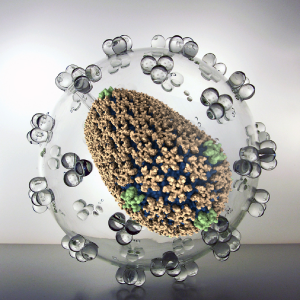
Viruses represent a serious public health threat and millions of people die every year from viral diseases. In an effort to prevent and combat viral infection, researchers worldwide are endeavoring to develop vaccines and drug-based treatments, particularly targeting virus capsids.
All-atom description of virus capsids has proven to be extremely valuable in accurately characterizing protein-protein interfaces and in revealing novel interactions between capsids and host factors / drug molecules. Here, innovations in computational modeling and simulation techniques will enable the study of (1) the effect of drug molecules on virus capsids and (2) the dynamic structure of RNA inside capsids.
A central challenge in the simulation of virus capsids (10-100 million atoms) consists in capturing their long-timescale dynamics. Large-scale MD simulations will be accelerated with the performance enhancement provided by petascale/exascale computing (TRD1) to extend current studies of complete capsids into the multi microsecond regime. Another key challenge to accurately describe the interactions between capsids and drug molecules is the inability of current force-fields to account for atomic polarizability. In response, NAMD will extend the use of polarizable forec fields (TRD1), such as the Drude oscillator model to systems with more than 10~million atoms. Furthermore, VMD will develop ffTK for Drude force field (TRD2) for routine parameterization of small-molecule drugs. A long-standing challenge in the computational study of virus capsids is the ability to account for the effects of RNA, as well as divalent cations, like magnesium (Mg2+), which are crucial for the structural integrity and biological activity of RNA; polarizable force field (TRD1) capabilities implemented in NAMD will also improve the modeling of interactions with divalent cations. To enable the inclusion of RNA in capsid simulations, a data-guided RNA modeling (TRD2) framework will be developed to incorporate expanded MDFF support for experimental data (TRD3) into MDFF calculations. Density map segmentation and manipulation (TRD2) tools coupled with advanced display and VR headsets (TRD2) will enable placement of RNA into the cryo-EM density. A further challenge in capsid simulations is presented by the inability to accurately account for the effects of environmental pH. A novel constant-pH (TRD1) algorithm will be extended to multi-million atom systems in tandem with the development of new visualization tools for constant-pH simulation and visualization (TRD2).
The study of virus capsids will build upon the Center's previous work on capsid structure and dynamics of the human immunodeficiency virus (HIV), hepatitis B virus (HBV), and other viruses. With NAMD's performance enhancements (TRD1), whole virus capsids will be simulated for several microseconds employing polarizable force fields. Further development to parameterize drug molecules using the ffTK for Drude (TRD2) and visualization of Drude simulations (TRD2) will enable the study of novel capsid-drug interactions of HIV and HBV with the input of experimental data such as cryo-EM (Zhang, Zlotnick), X-ray crystallography (Sarafianos, Zlotnick) and NMR (Gronenborn, Polenova). Atomic models of viral capsids at multiple pHs will be derived using the constant pH features developed by both TRD1 and TRD2 with experimental restraints derived from cryo-EM (Zhang, Zlotnick) and NMR (Polenova, Gronenborn). The described advances will enable investigation of the role of pH and drug binding in capsid assembly and maturation. The new RNA modeling (TRD2) technologies, which will be developed in collaboration with (Hofacker), will enable modeling of the pregenomic RNA of HBV by incorporating cryo-EM restraints (Zlotnick). Biochemical and genetic data (ZlotnickAiken, Craven) will then be employed to validate the structural models and simulation predictions obtained.