Stretching DNA
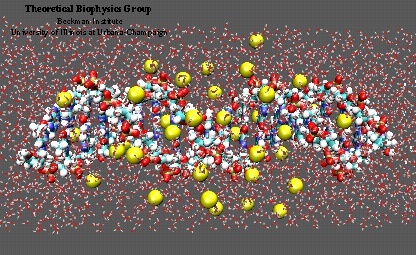
We are simulating the overstretching of B-form DNA. When one applies a monotonically increasing force to DNA, it is noticed that at first the length of the DNA strand increases in a Hooke's law fashion, but at a critical force the DNA gives, undergoes a structural transition, and doubles in length with almost no additional force needing to be applied.
The mechanism for this structural transition is not well understood. It is believed that the saltwater environment of the DNA plays a crucial role in the process. Thus, in order to accurately model the event, simulations must include water and counterions. This makes for a very large system and results in the need for parallel computation. In addition, the project uses some unconventional techniques in molecular dynamics. NAMD's object-oriented design has allowed for an easy addition of such specialized features (i.e. pulling forces).
So far we do notice a lengthening of the DNA, but as forces are applied and the DNA gives, problems develop in the aqueous environment. The water does not have enough time to diffuse itself naturally around the pulled end. New strategies must be developed in order to model these processes on simulation timescales. i.e. simulated annealing of the water, etc.