Aleksei Aksimentiev
Telephone: (217)-244-4932 Office address: 3025 Beckman Inst. Email: aksiment@uiuc.edu See also my page at the Department of Physics. |
Education:
|
Postdoctoral Training:
|
Research Highlights:Stretchable DNAThe most celebrated molecule of living cells, DNA, owes its fame to its role as a carrier of genetic information. But DNA is also impressive through other amazing properties, for example its mechanical flexibility. At first sight, it might seem a dull question to ask what is the smallest pore DNA can be squeezed through, as the obvious answer is that the diameter of that pore should be slightly larger than the diameter of a DNA helix. However, recent studies (paper1, paper2) in asking the stated question discovered that double stranded DNA can permeate, without loosing its structural integrity, pores smaller in diameter than a DNA double helix. The discovery was initiated through molecular dynamics simulations, carried out using NAMD and VMD. The simulations demonstrated that if an electrical field, driving negatively charged DNA through a nanopore, exceeds some critical value, the force exerted on DNA stretches DNA to twice its equilibrium length, reducing thereby its diameter and allowing it to squeeze through narrow pores. The simulations predicted precise values of pore radii and associated critical fields. The predictions were validated experimentally by counting the number of DNA copies that passed at different electric fields through synthetic nanopores. Further details about this study can be found here. |
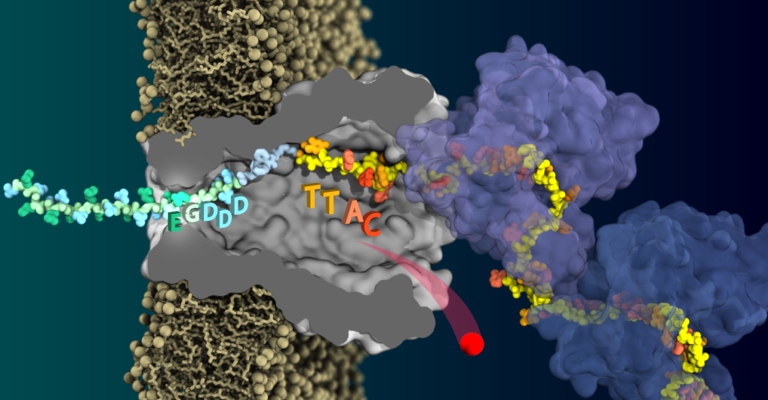
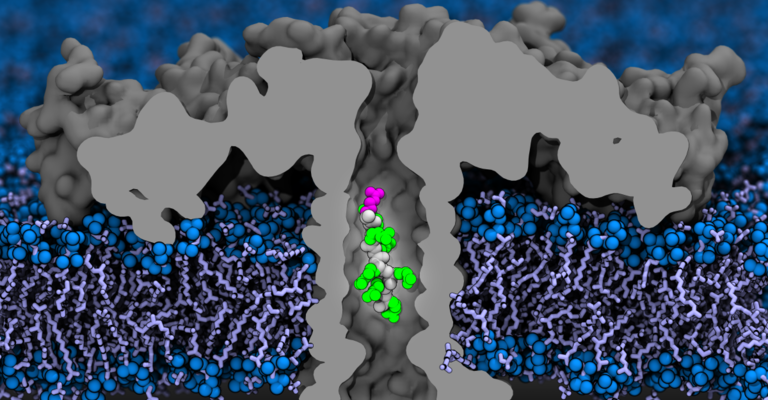
DNA smooth and RoughFor the sequence of DNA, the genetic instructions of cells, to be read, the double helix of DNA is split open, exposing single DNA strands to DNA binding proteins. Once bound to DNA, the proteins, in carrying out their functions, will crawl along the DNA strand in one of two directions, towards DNA's 3' or 5' end. A recent study of DNA discovered a surprising property of single DNA strands that seems to explain how DNA binding proteins recognize the right direction on DNA strands. By measuring the translocation of DNA through alpha-hemolysin, a membrane protein with a narrow pore, researches discovered that directed single stranded DNA moves much faster when entering the pore 3' end first, rather than 5' end first. The underlying mechanism of this directionality was discovered through molecular dynamics simulations using NAMD and VMD. The simulations revealed that, in a narrow pore, DNA bases tilt collectively towards the 5' end, transforming a wide space directionless DNA brush into a tight space DNA ratchet. The 360,000-atom MD simulation did not only reveal how the DNA bases align and move faster in the "smooth" direction, but did also predict how the directional DNA movement can be discerned by means of direction-sensitive ionic currents through the channel blocked by translocating DNA strands. More details about this study can be found here. |
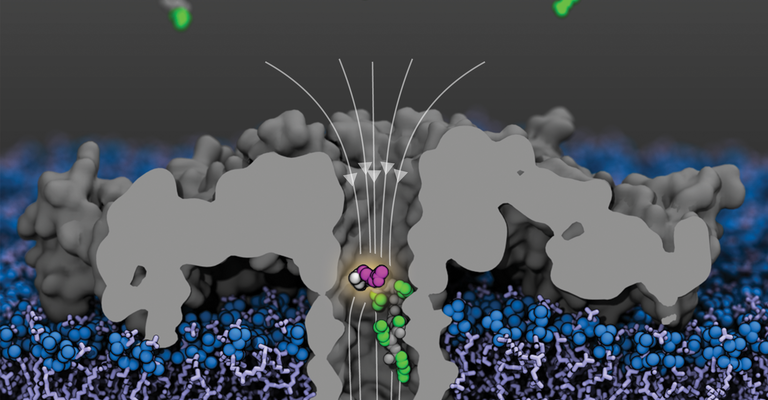
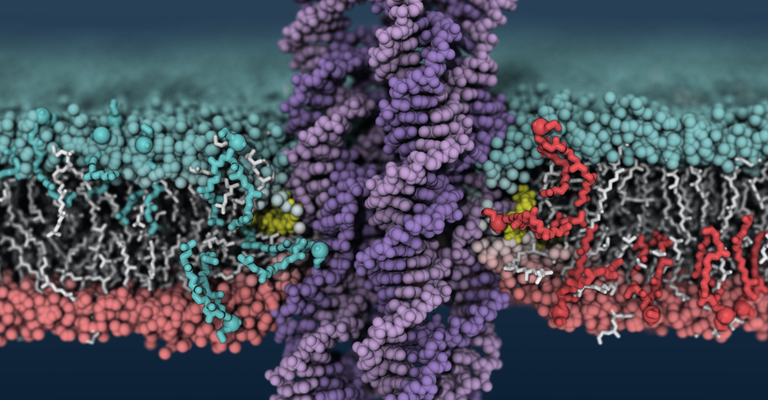
Imaging Alpha-Hemolysin with Molecular DynamicsIn a biological cell, membrane channels act like miniature valves regulating the flow of ions and other solutes between intracellular compartments and across the cell's boundary. Assembled in complex circuits, they generate, transmit, and amplify signals orchestrating cell function. To investigate how membrane channels work, life scientists, using an extremely fine pipette, isolate a tiny patch of a cell membrane and, in so-called patch clamp measurements, determine electric currents in response to applied electric potentials. Dramatic increase in computational power and its efficient utilization by NAMD allows one today to reproduce such studies computationally, calculating the permeability of a membrane channel to ions and water directly from its atomic structure. In what is one of the largest molecular dynamics simulation to date, described in a recent paper as well as on our web site (here), one copy of the membrane channel alpha-hemolysin, submerged in a lipid membrane and water, was subjected to an external electric field that drove ions and water through the channel. The calculations produced also an image of the electrostatic potential across the channel (see figure). |
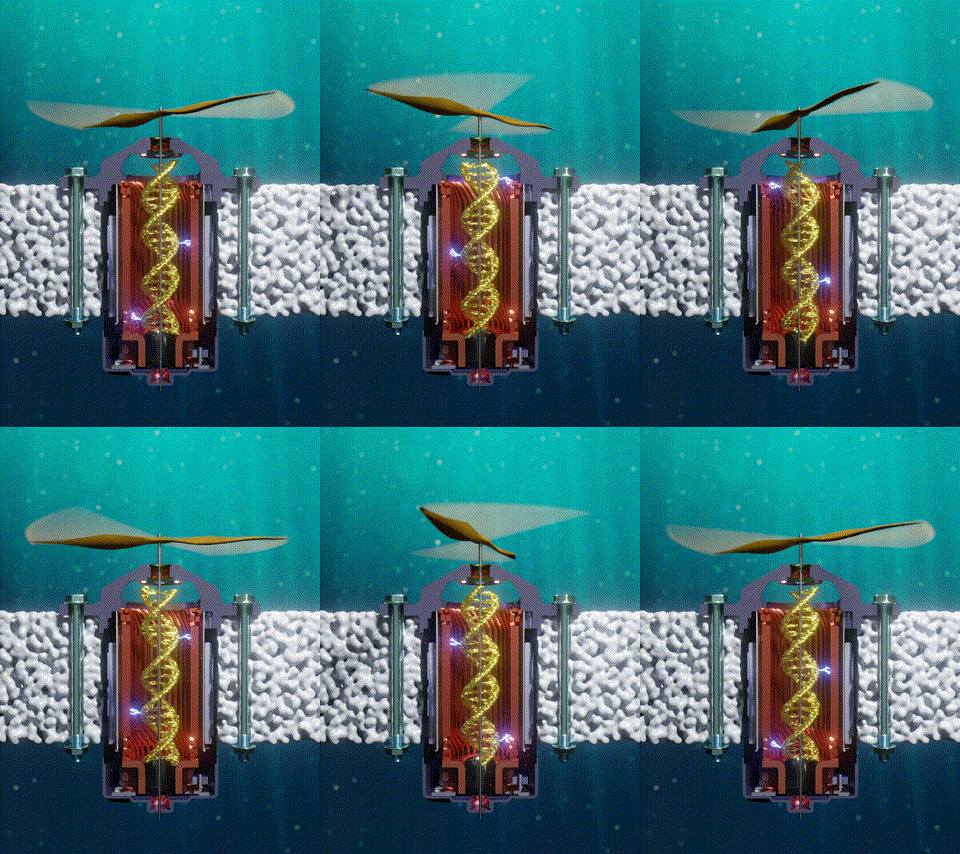
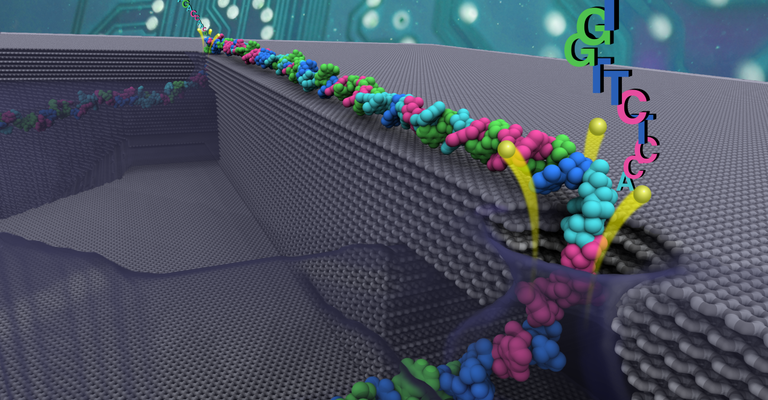
Transistor Meets DNAElectrical devices on computer chips built from silicon compounds have reached the small length scales of the building blocks in biomolecules, namely, the amino acids in proteins and the bases in DNA. Using beams of electron microscopes, electrical engineers drill nanometer wide pores into silicon wafers that contain a central layer only a few atoms thick. The engineers surround these pores with transistors and electrodes that can detect charges moving in the nanopore. Electrical fields across such synthetic nanopores can thread charged molecules like DNA through, and electrical signals stemming from single molecules transiting the pores can be recorded. Since the size of the nanopores compares with the dimension of DNA bases, the signals should eventually become precise enough to distinguish DNA bases, such that nanopores can become recording heads reading off sequences of DNA. While such ultrafast recording of DNA sequences is still a distant goal, the manufactured nanopores have been used already for sizing short strands of DNA as reported recently (report1, report2). Molecular dynamics simulations with NAMD and molecular graphics with VMD played a crucial role in imaging the dynamic events (movies available here) involved in recording single molecules of DNA and for optimizing the design of nanopores towards efficient threading and accurate recording. The landmark collaboration between computational biologists and device engineers promises to further unlock the great potential of biomedical nanotechnology. |
Biological Motor Running a Billion Yearsimage size:
245.6KB
What will car motors look like in a million years? It's hard to tell, but biological cells seem to have found an ideal engine that they use since the early days of evolution. A spoonful of their engines generates about as much total torque as the strongest car engine today. The engine is called FoF1-ATP synthase and synthesizes the molecule ATP by combining two generator-like motors, Fo-ATPase and F1-ATPase, coupled through a single axle, one motor (Fo) that converts the cell's electrical energy into rotation, another one (F1) that converts rotation into chemical synthesis (see November 2003 highlight). ATP synthase, found throughout the whole kingdom of life, can also work in reverse, turning ATP into electrical energy. Cells typically use the energy of sun light or of food to generate an electrical potential by pumping protons that carry a positive charge across their cell membrane. The energy stored drives the protons back through Fo-ATPase enforcing rotation of the axle; the rotation in turn induces ATP synthesis in F1-ATPase. In one of the largest computational and mathematical biomodeling projects undertaken to this day and reported recently, researchers build from available disjoint structural data a model of Fo-ATPase and demonstrated its function as a motor turning proton conduction into rotation of a cylindrical protein complex. By linking nanosecond molecular modeling to a mathematical model of the motor's key elements, they could follow Fo-ATPase function properly, even when the load arising from driving synthesis in F1-ATPase was added. FoF1-ATP synthase being one of the largest molecular machines in biological cells, modelers needed to employ for its study the most advanced tools, NAMD and massively parallel computers, along with a new approach that combined molecular dynamics and stochastic mathematics. |
Detecting the orientation of a DNA strand with a nanopore.
Imaging the permeability of
an ion channel /
Movies.
Molecular mechanism
of torque generation by Fo ATP synthase.
/ Movies.
Sequencing DNA with a nanopore device. / Movies.
|
Publications at TCBG:Detection of DNA sequences using an alternating electric field in a nanopore capacitor. G. Sigalov, J. Comer, G. Timp, and A. Aksimentiev. Nano Letters, 8:56-63, 2008. Stretching and unzipping nucleic acid hairpins using a synthetic nanopore. Q. Zhao, J. Comer, S. Yemenicioglu, A. Aksimentiev, and G. Timp. Nucleic Acids Research, 36:1532-1541, 2008. In meso crystal structure and computer simulations suggest an alternative proteoglycan binding site in the OpcA outer membrane adhesin. V. Cherezov, W. Liu, J. Derrick, B. Luan, A. Aksimentiev, V. Katruc, and M. Caffrey. PROTEINS: Structure, Function, and Bioinformatics, 2007. In press. Exploring transmembrane transport through alpha-hemolysin with grid-steered molecular dynamics. David Wells, Volha Abramkina, and Aleksei Aksimentiev. Journal of Chemical Physics, 127:125101-125110, 2007. Structure refinement of the OpcA adhesin using molecular dynamics. Binquan Luan, Martin Caffrey, and Aleksei Aksimentiev. Biophysical Journal, 93:3058-3069, 2007. Detecting SNPs using a synthetic nanopore. Q. Zhao, G. Sigalov, V. Dimitrov, B. Dorvel, U. Mirsaidov, S. Sligar, A. Aksimentiev, and G. Timp. Nano Letters, 7:1680-1685, 2007. Electrical signatures of single-stranded DNA with single base mutations in a nanopore capacitor. Maria E. Gracheva, Aleksei Aksimentiev, and Jean-Pierre Leburton. Nanotechnology, 17:3160-3165, 2006. Computer modeling in biotechnology, a partner in development. Aleksei Aksimentiev, Robert Brunner, Jordi Cohen, Jeffrey Comer, Eduardo Cruz-Chu, David Hardy, Aruna Rajan, Amy Shih, Grigori Sigalov, Ying Yin, and Klaus Schulten. In Protocols in Nanostructure Design, Methods in Molecular Biology. Humana Press, 2008. In press. Water-silica force field for simulating nanodevices. Eduardo R. Cruz-Chu, Aleksei Aksimentiev, and Klaus Schulten. Journal of Physical Chemistry B, 110:21497-21508, 2006. The role of molecular modeling in bionanotechnology. Deyu Lu, Aleksei Aksimentiev, Amy Y. Shih, Eduardo Cruz-Chu, Peter L. Freddolino, Anton Arkhipov, and Klaus Schulten. Physical Biology, 3:S40-S53, 2006. Simulation of the electric response of DNA translocation through a semiconductor nanopore-capacitor. Maria E. Gracheva, Anlin Xiong, Jean-Pierre Leburton, Aleksei Aksimentiev, Klaus Schulten, and Gregory Timp. Nanotechnology, 17:622-633, 2006. The electromechanics of DNA in a synthetic nanopore. J. B. Heng, A. Aksimentiev, C. Ho, P. Marks, Y. V. Grinkova, S. Sligar, K. Schulten, and G. Timp. Biophysical Journal, 90:1098-1106, 2006. Orientation discrimination of single stranded DNA inside the a-hemolysin membrane channel. Jerome Mathé, Aleksei Aksimentiev, David R. Nelson, Klaus Schulten, and Amit Meller. Proceedings of the National Academy of Sciences, USA, 102:12377-12382, 2005. Molecular dynamics simulations of proteins in lipid bilayers. James Gumbart, Yi Wang, Alekseij Aksimentiev, Emad Tajkhorshid, and Klaus Schulten. Current Opinion in Structural Biology, 15:423-431, 2005. Beyond the gene chip. J. B. Heng, A. Aksimentiev, C. Ho, V. Dimitrov, T. Sorsch, J. Miner, W. Mansfield, K. Schulten, and G. Timp. Bell Labs Technical Journal, 10:5-22, 2005. Stretching DNA using an electric field in a synthetic nanopore. J. B Heng, A. Aksimentiev, C. Ho, P. Marks, Y. V. Grinkova, S. Sligar, K. Schulten, and G. Timp. Nano Letters, 5:1883-1888, 2005. Imaging alpha-hemolysin with molecular dynamics: Ionic conductance, osmotic permeability and the electrostatic potential map. Aleksij Aksimentiev and Klaus Schulten. Biophysical Journal, 88:3745-3761, 2005. Towards understanding membrane channels. Emad Tajkhorshid, Jordi Cohen, Aleksij Aksimentiev, Marcos Sotomayor, and Klaus Schulten. In Boris Martinac and Andrzej Kubalski, editors, Bacterial ion channels and their eukaryotic homologues, pp. 153-190. ASM Press, Washington, DC, 2005. Microscopic kinetics of DNA translocation through synthetic nanopores. Aleksij Aksimentiev, Jiunn Benjamin Heng, Gregory Timp, and Klaus Schulten. Biophysical Journal, 87:2086-2097, 2004. Sizing DNA using a nanometer-diameter pore. J. B. Heng, C. Ho, T. Kim, R. Timp, A. Aksimentiev, Y. V. Grinkova, S. Sligar, K. Schulten, and G. Timp. Biophysical Journal, 87:2905-2911, 2004. Extending the molecular modeling methodology to study insertion of membrane nanopores. Aleksij Aksimentiev and Klaus Schulten. Proceedings of the National Academy of Sciences, USA, 101:4337-4338, 2004. Insights into the molecular mechanism of rotation in the Fo sector of ATP synthase. Aleksij Aksimentiev, Ilya A. Balabin, Robert H. Fillingame, and Klaus Schulten. Biophysical Journal, 86:1332-1344, 2004. Large scale simulation of protein mechanics and function. Emad Tajkhorshid, Aleksij Aksimentiev, Ilya Balabin, Mu Gao, Barry Isralewitz, James C. Phillips, Fangqiang Zhu, and Klaus Schulten. In Frederic M. Richards, David S. Eisenberg, and John Kuriyan, editors, Advances in Protein Chemistry, volume 66, pp. 195-247. Elsevier Academic Press, New York, 2003. |

M.Sc.,
(Physics) 1996 -