# given the selection, get the CAs and draw a distance plot
#VMD --- start of VMD description block
#Name:
# CA distance plot
#Synopsis:
# Given a selection, plot the CA-CA distance plot
#Version:
# 1.0
#Uses VMD version:
# 1.1
#Ease of use:
# 2
#Procedures:
# vecdist v1 v2 -- computes the norm of v2 - v1 (which are vectors
# of length 3)
# ca_dist selection -- makes a new graphics molecule which is
# the CA-CA distance plot of the given selection
#Description:
# Given a selection, this script finds the CA atoms and constructs a
# matrix whose elements are the distances from the CA of residue(i) to
# that on residue(j). A new graphics molecule is created with the name
# "CA_distance(molid)", where molid is the index of the molecule used
# by the selection. The distance matrix is plotted by residue number
# in the order they appeared in the PDB (or PSF, ...) file, but only
# the selected residues are shown. The colors are determined by the
# color scale and may be changed accordingly.
#Example output:
# 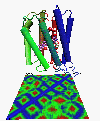 image
# of bacteriorhodopsin with the CA-CA on the bottom
#Files:
# ca-dist.vmd
#Author:
# Andrew Dalke <dalke@ks.uiuc.edu>
#\VMD --- end of block
# Input: two vectors of length three (v1 and v2)
# Returns: ||v2-v1||
# This is almost twice the speed as "veclength [vecsub $v1 $v2]"
# and gives ~10% overall performance increase
proc vecdist {v1 v2} {
lassign $v1 x1 x2 x3
lassign $v2 y1 y2 y3
return [expr sqrt(pow($x1-$y1,2) + pow($x2-$y2,2) + pow($x3-$y3, 2))]
}
# Input: a selection
# Does: finds the CAs in the selection then computes and draws the
# CA-CA distance grid with colors based on the color scale
# Returns: the id of the new graphics molecule containing the grid
# In terms of timing, 1/3 is spent in the first big loop,
# and the 2/3 in the second loop is shared between the Tcl commands
# and the three 'graphics' commands. This routine takes about
# 70 seconds (on a Crimson) for 234 residues (which is 27495
# distance calculations and 54756*2 triangles!).
proc ca_distance {main_sel} {
# get the CA atoms from the selection
set mol [$main_sel molindex]
set sel [atomselect $mol "@$main_sel and name CA"]
# find distances between each pair
set coords [$sel get {x y z}]
set max 0
set list2 [$sel list]
foreach atom1 $coords id1 [$sel list] {
foreach atom2 $coords id2 $list2 {
set dist($id1,$id2) [vecdist $atom2 $atom1]
set dist($id2,$id1) $dist($id1,$id2)
set max [max $max $dist($id1,$id2)]
}
lvarpop list2
lvarpop coords
}
# draw the pretty graphic
puts "Distances calculated, now drawing the distance map ..."
mol load graphics "CA_distance($mol)"
set gmol [molinfo top]
# turn material characteristics off
graphics $gmol materials off
# i1 and j1 are i+1 and j+1; this speeds up construction of x{01}{01}
set i 0
set i1 1
# preset the scaling factor (31.95 instead of 32 ensures there will be
# no color 66 (for the max color), which is transparent)
set scale [expr 31.95 / ($max + 0.)]
set list2 [$sel list]
foreach id1 [$sel list] {
set j 0
set j1 1
set x00 "$i $j 0"
set x10 "$i1 $j 0"
set x11 "$i1 $j1 0"
set x01 "$i $j1 0"
foreach id2 $list2 {
set col [expr int($scale * $dist($id1,$id2)) + 34]
graphics $gmol color $col
graphics $gmol triangle $x00 $x10 $x11
graphics $gmol triangle $x00 $x11 $x01
incr j
incr j1
set x00 $x01
set x10 $x11
set x11 "$i1 $j1 0"
set x01 "$i $j1 0"
}
incr i
incr i1
}
# put some numbers down to give an idea of what is where
set resids [$sel get resid]
set num [llength $resids]
set start [lindex $resids 0]
set end [lindex $resids [expr $num - 1]]
graphics $gmol color yellow
graphics $gmol text "0 0 0" "$start,$start"
graphics $gmol text "$num 0 0" "$end,$start"
graphics $gmol text "0 $num 0" "$start,$end"
graphics $gmol text "$num $num 0" "$end,$end"
return $gmol
}
image
# of bacteriorhodopsin with the CA-CA on the bottom
#Files:
# ca-dist.vmd
#Author:
# Andrew Dalke <dalke@ks.uiuc.edu>
#\VMD --- end of block
# Input: two vectors of length three (v1 and v2)
# Returns: ||v2-v1||
# This is almost twice the speed as "veclength [vecsub $v1 $v2]"
# and gives ~10% overall performance increase
proc vecdist {v1 v2} {
lassign $v1 x1 x2 x3
lassign $v2 y1 y2 y3
return [expr sqrt(pow($x1-$y1,2) + pow($x2-$y2,2) + pow($x3-$y3, 2))]
}
# Input: a selection
# Does: finds the CAs in the selection then computes and draws the
# CA-CA distance grid with colors based on the color scale
# Returns: the id of the new graphics molecule containing the grid
# In terms of timing, 1/3 is spent in the first big loop,
# and the 2/3 in the second loop is shared between the Tcl commands
# and the three 'graphics' commands. This routine takes about
# 70 seconds (on a Crimson) for 234 residues (which is 27495
# distance calculations and 54756*2 triangles!).
proc ca_distance {main_sel} {
# get the CA atoms from the selection
set mol [$main_sel molindex]
set sel [atomselect $mol "@$main_sel and name CA"]
# find distances between each pair
set coords [$sel get {x y z}]
set max 0
set list2 [$sel list]
foreach atom1 $coords id1 [$sel list] {
foreach atom2 $coords id2 $list2 {
set dist($id1,$id2) [vecdist $atom2 $atom1]
set dist($id2,$id1) $dist($id1,$id2)
set max [max $max $dist($id1,$id2)]
}
lvarpop list2
lvarpop coords
}
# draw the pretty graphic
puts "Distances calculated, now drawing the distance map ..."
mol load graphics "CA_distance($mol)"
set gmol [molinfo top]
# turn material characteristics off
graphics $gmol materials off
# i1 and j1 are i+1 and j+1; this speeds up construction of x{01}{01}
set i 0
set i1 1
# preset the scaling factor (31.95 instead of 32 ensures there will be
# no color 66 (for the max color), which is transparent)
set scale [expr 31.95 / ($max + 0.)]
set list2 [$sel list]
foreach id1 [$sel list] {
set j 0
set j1 1
set x00 "$i $j 0"
set x10 "$i1 $j 0"
set x11 "$i1 $j1 0"
set x01 "$i $j1 0"
foreach id2 $list2 {
set col [expr int($scale * $dist($id1,$id2)) + 34]
graphics $gmol color $col
graphics $gmol triangle $x00 $x10 $x11
graphics $gmol triangle $x00 $x11 $x01
incr j
incr j1
set x00 $x01
set x10 $x11
set x11 "$i1 $j1 0"
set x01 "$i $j1 0"
}
incr i
incr i1
}
# put some numbers down to give an idea of what is where
set resids [$sel get resid]
set num [llength $resids]
set start [lindex $resids 0]
set end [lindex $resids [expr $num - 1]]
graphics $gmol color yellow
graphics $gmol text "0 0 0" "$start,$start"
graphics $gmol text "$num 0 0" "$end,$start"
graphics $gmol text "0 $num 0" "$start,$end"
graphics $gmol text "$num $num 0" "$end,$end"
return $gmol
} image
# of bacteriorhodopsin with the CA-CA on the bottom
#Files:
# ca-dist.vmd
#Author:
# Andrew Dalke <dalke@ks.uiuc.edu>
#\VMD --- end of block
# Input: two vectors of length three (v1 and v2)
# Returns: ||v2-v1||
# This is almost twice the speed as "veclength [vecsub $v1 $v2]"
# and gives ~10% overall performance increase
proc vecdist {v1 v2} {
lassign $v1 x1 x2 x3
lassign $v2 y1 y2 y3
return [expr sqrt(pow($x1-$y1,2) + pow($x2-$y2,2) + pow($x3-$y3, 2))]
}
# Input: a selection
# Does: finds the CAs in the selection then computes and draws the
# CA-CA distance grid with colors based on the color scale
# Returns: the id of the new graphics molecule containing the grid
# In terms of timing, 1/3 is spent in the first big loop,
# and the 2/3 in the second loop is shared between the Tcl commands
# and the three 'graphics' commands. This routine takes about
# 70 seconds (on a Crimson) for 234 residues (which is 27495
# distance calculations and 54756*2 triangles!).
proc ca_distance {main_sel} {
# get the CA atoms from the selection
set mol [$main_sel molindex]
set sel [atomselect $mol "@$main_sel and name CA"]
# find distances between each pair
set coords [$sel get {x y z}]
set max 0
set list2 [$sel list]
foreach atom1 $coords id1 [$sel list] {
foreach atom2 $coords id2 $list2 {
set dist($id1,$id2) [vecdist $atom2 $atom1]
set dist($id2,$id1) $dist($id1,$id2)
set max [max $max $dist($id1,$id2)]
}
lvarpop list2
lvarpop coords
}
# draw the pretty graphic
puts "Distances calculated, now drawing the distance map ..."
mol load graphics "CA_distance($mol)"
set gmol [molinfo top]
# turn material characteristics off
graphics $gmol materials off
# i1 and j1 are i+1 and j+1; this speeds up construction of x{01}{01}
set i 0
set i1 1
# preset the scaling factor (31.95 instead of 32 ensures there will be
# no color 66 (for the max color), which is transparent)
set scale [expr 31.95 / ($max + 0.)]
set list2 [$sel list]
foreach id1 [$sel list] {
set j 0
set j1 1
set x00 "$i $j 0"
set x10 "$i1 $j 0"
set x11 "$i1 $j1 0"
set x01 "$i $j1 0"
foreach id2 $list2 {
set col [expr int($scale * $dist($id1,$id2)) + 34]
graphics $gmol color $col
graphics $gmol triangle $x00 $x10 $x11
graphics $gmol triangle $x00 $x11 $x01
incr j
incr j1
set x00 $x01
set x10 $x11
set x11 "$i1 $j1 0"
set x01 "$i $j1 0"
}
incr i
incr i1
}
# put some numbers down to give an idea of what is where
set resids [$sel get resid]
set num [llength $resids]
set start [lindex $resids 0]
set end [lindex $resids [expr $num - 1]]
graphics $gmol color yellow
graphics $gmol text "0 0 0" "$start,$start"
graphics $gmol text "$num 0 0" "$end,$start"
graphics $gmol text "0 $num 0" "$start,$end"
graphics $gmol text "$num $num 0" "$end,$end"
return $gmol
}
image
# of bacteriorhodopsin with the CA-CA on the bottom
#Files:
# ca-dist.vmd
#Author:
# Andrew Dalke <dalke@ks.uiuc.edu>
#\VMD --- end of block
# Input: two vectors of length three (v1 and v2)
# Returns: ||v2-v1||
# This is almost twice the speed as "veclength [vecsub $v1 $v2]"
# and gives ~10% overall performance increase
proc vecdist {v1 v2} {
lassign $v1 x1 x2 x3
lassign $v2 y1 y2 y3
return [expr sqrt(pow($x1-$y1,2) + pow($x2-$y2,2) + pow($x3-$y3, 2))]
}
# Input: a selection
# Does: finds the CAs in the selection then computes and draws the
# CA-CA distance grid with colors based on the color scale
# Returns: the id of the new graphics molecule containing the grid
# In terms of timing, 1/3 is spent in the first big loop,
# and the 2/3 in the second loop is shared between the Tcl commands
# and the three 'graphics' commands. This routine takes about
# 70 seconds (on a Crimson) for 234 residues (which is 27495
# distance calculations and 54756*2 triangles!).
proc ca_distance {main_sel} {
# get the CA atoms from the selection
set mol [$main_sel molindex]
set sel [atomselect $mol "@$main_sel and name CA"]
# find distances between each pair
set coords [$sel get {x y z}]
set max 0
set list2 [$sel list]
foreach atom1 $coords id1 [$sel list] {
foreach atom2 $coords id2 $list2 {
set dist($id1,$id2) [vecdist $atom2 $atom1]
set dist($id2,$id1) $dist($id1,$id2)
set max [max $max $dist($id1,$id2)]
}
lvarpop list2
lvarpop coords
}
# draw the pretty graphic
puts "Distances calculated, now drawing the distance map ..."
mol load graphics "CA_distance($mol)"
set gmol [molinfo top]
# turn material characteristics off
graphics $gmol materials off
# i1 and j1 are i+1 and j+1; this speeds up construction of x{01}{01}
set i 0
set i1 1
# preset the scaling factor (31.95 instead of 32 ensures there will be
# no color 66 (for the max color), which is transparent)
set scale [expr 31.95 / ($max + 0.)]
set list2 [$sel list]
foreach id1 [$sel list] {
set j 0
set j1 1
set x00 "$i $j 0"
set x10 "$i1 $j 0"
set x11 "$i1 $j1 0"
set x01 "$i $j1 0"
foreach id2 $list2 {
set col [expr int($scale * $dist($id1,$id2)) + 34]
graphics $gmol color $col
graphics $gmol triangle $x00 $x10 $x11
graphics $gmol triangle $x00 $x11 $x01
incr j
incr j1
set x00 $x01
set x10 $x11
set x11 "$i1 $j1 0"
set x01 "$i $j1 0"
}
incr i
incr i1
}
# put some numbers down to give an idea of what is where
set resids [$sel get resid]
set num [llength $resids]
set start [lindex $resids 0]
set end [lindex $resids [expr $num - 1]]
graphics $gmol color yellow
graphics $gmol text "0 0 0" "$start,$start"
graphics $gmol text "$num 0 0" "$end,$start"
graphics $gmol text "0 $num 0" "$start,$end"
graphics $gmol text "$num $num 0" "$end,$end"
return $gmol
}